
Function Analysis Exercise 9
We are asked to analyze the function
$$ f(x) = \sqrt{x^2 - 16} $$
using the standard techniques of differential calculus.
Domain
The square root is defined only when its argument is non-negative:
$$ x^2 - 16 \geq 0 $$
$$ x^2 \geq 16 $$
Taking square roots and considering both signs gives:
$$ |x| \geq 4 $$
Hence, the domain is:
$$ D_f = (-\infty, -4] \cup [4, \infty) $$
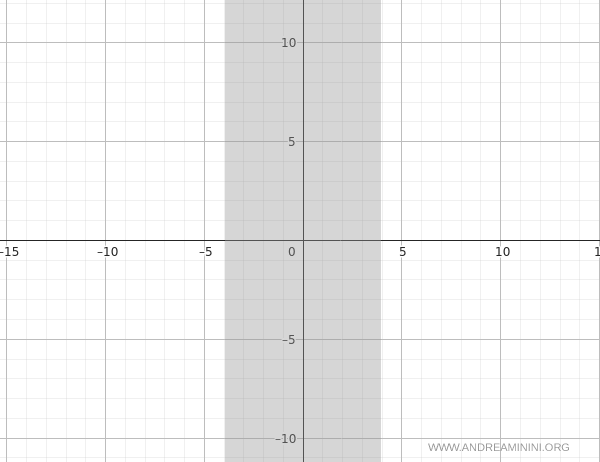
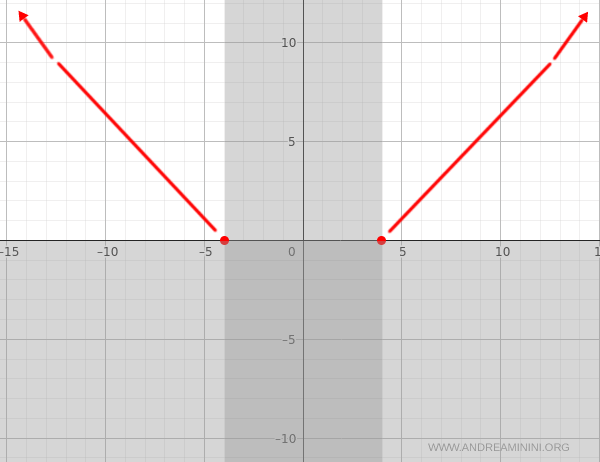
On the graph, the interval \( (-4, 4) \) must be excluded, as the function is undefined there.
Intercepts
There is no y-intercept since \( f(0) \) is undefined.
To find the x-intercepts, we solve:
$$ \sqrt{x^2 - 16} = 0 $$
Squaring both sides yields:
$$ x^2 - 16 = 0 \quad \Rightarrow \quad x^2 = 16 $$
Thus:
$$ x = \pm 4 $$
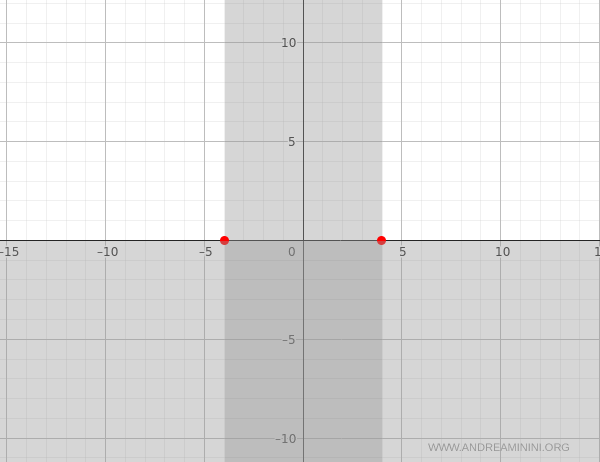
The function intersects the x-axis at the points \( (-4, 0) \) and \( (4, 0) \).
Sign Analysis
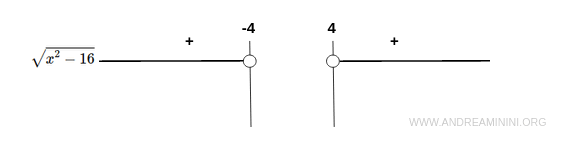
Being a square root, the function takes only non-negative values. It is strictly positive everywhere in its domain, except at the boundary points \( x = \pm 4 \), where it equals zero.
Therefore, the graph lies entirely on or above the x-axis, and the lower half-plane can be disregarded.
Asymptotic Behavior
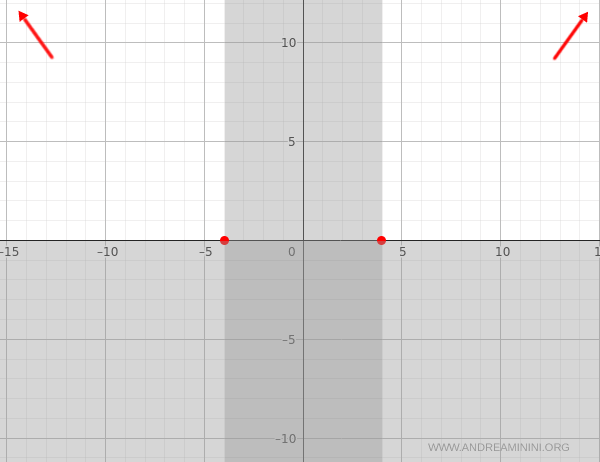
Consider the end behavior as \( x \to \pm\infty \):
$$ \lim_{x \to \infty} \sqrt{x^2 - 16} = +\infty, \quad \lim_{x \to -\infty} \sqrt{x^2 - 16} = +\infty $$
In both directions, the function diverges to infinity.
Monotonicity
The first derivative is:
$$ f'(x) = \frac{d}{dx}\left(\sqrt{x^2 - 16}\right) = \frac{x}{\sqrt{x^2 - 16}} $$
Its sign depends directly on the numerator:
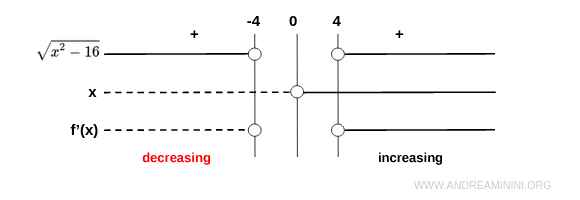
For \( x < -4 \), \( f'(x) < 0 \): the function decreases. For \( x > 4 \), \( f'(x) > 0 \): the function increases.
Local Extrema
The derivative never vanishes within the domain, so there are no local maxima or minima in the usual sense.
Concavity and Inflection Points
Now let us compute the second derivative:
$$ f''(x) = \frac{d}{dx}\left(\frac{x}{\sqrt{x^2 - 16}}\right) $$
After simplification, we obtain:
$$ f''(x) = \frac{-16}{(x^2 - 16)\sqrt{x^2 - 16}} $$
This is always negative throughout the domain.
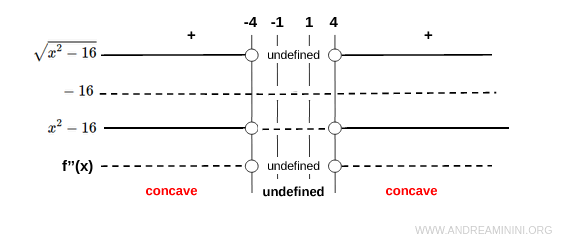
Therefore, \( f(x) \) is concave downward everywhere it is defined: on both \( (-\infty, -4] \) and \( [4, \infty) \).
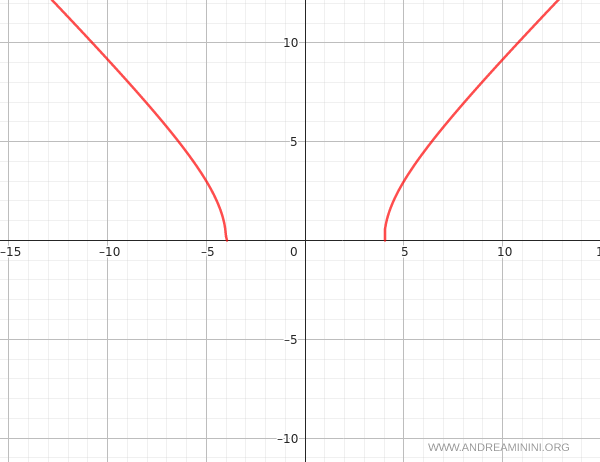
With this, the essential features of the graph are fully determined.


